Gold near $3,500: down 37%, yet central banks keep buying
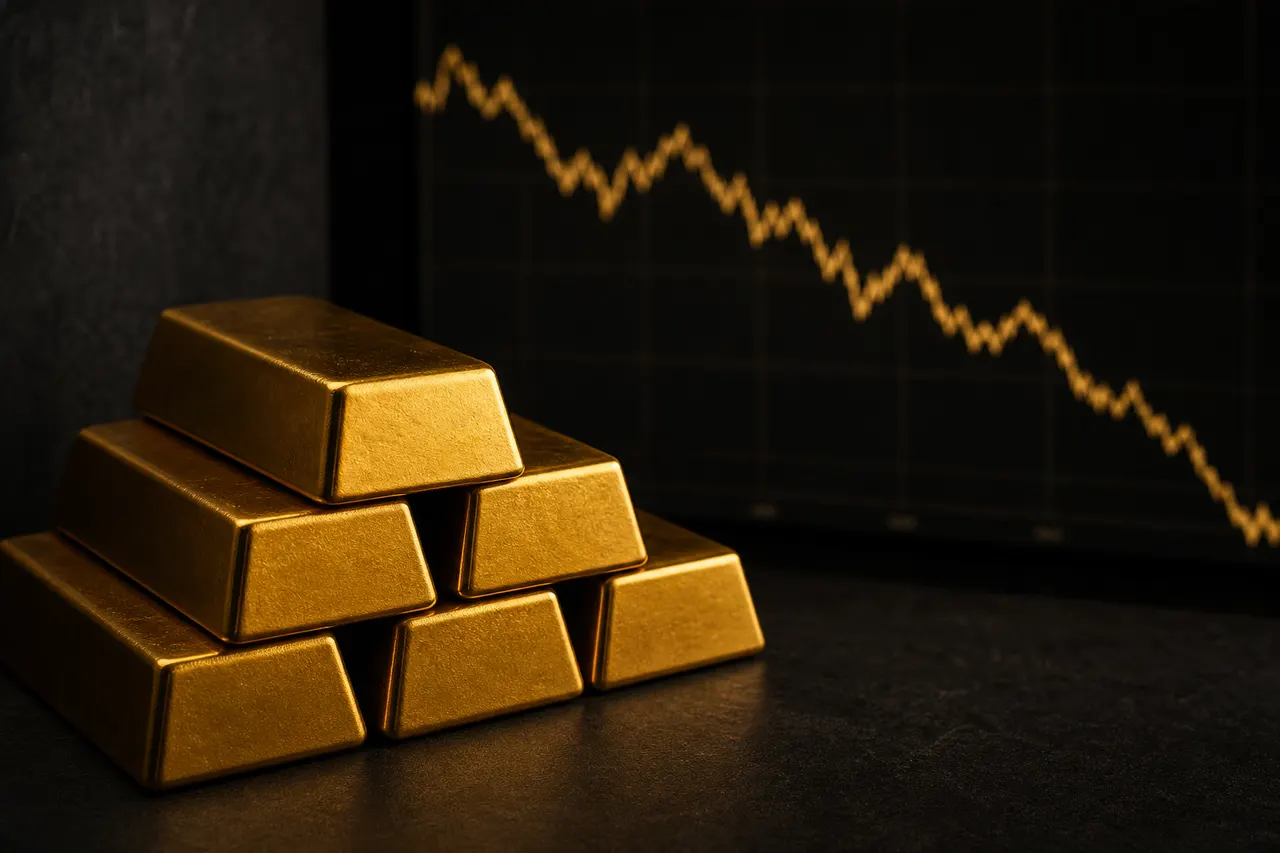
Gold slips back to roughly $3,520 to $3,560 after Monday's bounce. The price sits about 37 percent below its record high. Central banks keep buying and support physical demand.
Key takeaways
- Gold trades around $3,520 to $3,560, close to Friday's low of $3,502.
- The price sits roughly 37 percent below its record high from the start of the year.
- Central banks bought 321 tonnes in the third quarter, 42 percent more than a year earlier.
Gold (XAU) is doing the opposite of what investors expect from a crisis metal. Despite conflict in the Middle East and sticky inflation, the price keeps sliding: after $3,689 on Monday, it is back at roughly $3,520 to $3,560 on Wednesday. At the same time, central banks are buying at a pace rarely seen.
A safe haven that fails to hold
The downtrend has run since late January and has cost gold about 37 percent from its peak. Bravos Research calculates that more than ten trillion dollars in value has vanished from the gold market this year. Particularly painful: the price fell below $4,000 and broke a three-year uptrend. Financial journalist Stefan Jäger therefore sees the bounce at the start of the week as a flash in the pan.
Who is selling, and why
Several forces act together. First, rising interest rates: they make interest-bearing government bonds more attractive and make credit for leveraged bets more expensive. Second, the futures exchange CME tightened its rules. The margin per gold future first rose from $20,000 to $24,000, and in January a percentage-based model followed. Anyone trading with leverage had to post more capital or close positions. Bravos Research notes that something similar preceded the crashes of 1980 and 2011.
According to Markus Fugmann, there is also a liquidity problem. He suspects that Gulf states have to sell to plug holes, and that the selling pressure hits AI stocks and gold alike. The Nasdaq 100 is said to trade below its level before the rally around Nvidia CEO Jensen Huang.
The buyers in the background
Demand remains robust. The World Gold Council counted about 5,000 tonnes for 2025, a record, and 2026 demand has so far stayed at a similar level. Central banks bought a net 321 tonnes in the third quarter, up 42 percent. Supply barely grows: in 2025, roughly 3,672 tonnes came from mines and 1,404 tonnes from recycling.
What momentum says
Momentum signals downward pressure. The 4-hour, daily and weekly charts are bearish; only the 1-hour timeframe is neutral. At the time of the snapshot, gold stood at $3,561.
Scenarios
If gold falls below $3,502, the downtrend is confirmed. According to Bravos Research, further Fed rate hikes could mean an additional decline of five to ten percent; the pattern of 1980 and 2011 would arithmetically point to about $2,500.
If the economy tips instead, the picture changes. The real-time forecast for US growth has halved from about six to three percent within three months. Should the Fed have to ease despite high inflation, the analysts consider a rally conceivable, comparable to the one from 2023 to 2026. Both are assessments by the sources, not forecasts by Trading Department.
Sources
- Finanzmarktwelt · finanzmarktwelt.de
- Finanzmarktwelt · finanzmarktwelt.de